Print Friendly and PDF
Showing posts with label Blanshard. Show all posts

Thursday, 2 April 2020

Memories of Oak River Memorial Rink


Following up on the previous post on my 52 Ancestors Blog about the school I attended, this one is about the rink where I spent many hours as a child learning to skate and socializing with the Oak River, Manitoba community.  My school classes skated and curled and the building was well used during the annual summer fair and other events.  The sources for my writing today are the local Blanshard history books as well as the little blue-covered booklet pictured written by Harold Griffiths (1903-2009).  Thanks to his great-nephew Garry Bridgeman and his wife Grace for sending it to me along with clippings about the rebuilding.  They knew how much I would enjoy them and put them to good use!

Discussions to build a new rink began in 1948 when a group of local people raffled off a car and were able to raise $6000, according to Mr. Griffiths' book.  There was an airplane hangar being sold from the former RCAF station at Neepawa for that exact amount and plans began.


The first men’s curling club in Oak River was organized in 1900. They used a temporary rink until 1914 when a building was built to be the curling rink in the winter and the agricultural exhibition building in the summer. It was built north of present #24 highway on the agricultural grounds where it has always been since. Outdoor hockey facilities were used for both men’s and ladies' clubs forming just after the turn of the century. According to 1984 Blanshard history book, the 1914 building had a waiting room and 3 sheets of curling ice encircled by a 14 foot wide sheet of skating ice.

Demand for more modern facilities after WW2 led to construction starting in 1948 with disassembly of the hangar and transporting all the bits and pieces to Oak River.  Doors, windows, roofing, siding, lights, switches, gyproc and wires made their way over the 54 miles in 14 days with volunteer trucks and labour.  Art Glinz is credited with keeping all the materials organized and storing them in the old school which he had purchased as well as in Tom Paxton's barn.  Mr. Griffiths describes the dangerous job of lowering and moving the huge beams that would be the ribs of the facility. An engineer was hired for a while but there was a lack of funds to keep him on.  Volunteers worked away at the process over the next 3 winters.


The Oak River Memorial Rink opened January 10, 1953 and it was built at an estimated cost of $30,000. The skating ice was 72 x 178. With a wooden dance floor over the ice surface, it held 500 people with standing room for 500 more. The dance gardens in Oak River were famous and many people I have met over the years would associate my hometown with dances. Famous entertainers like Don Messer, Mart Kenny, Tommy Hunter and Frankie Yankovic stopped in Oak River in the 50’s. I have been told that Fred Glinz was the organizer of these dances for years and other performers included Marty Robbins, The Trashmen, Bobby Curtola and Bill and Sue-On Hillman.  At one time the dance floor featured a rainbow mural as well as stars suspended overhead. The 4 sheets of curling ice were converted to artificial in 1967 for a cost of $14,000. The waiting room in the main rink seated 200 people.

If you were ever there, take a walk with me through the main doors, past the ticket booth and you see the back of rows of dark red velvet theatre chairs facing out on the skating ice. Dressing rooms with mint green painted doors and cupboards are to your left and down the hall to your right was an office and washrooms leading to the waiting room. The lunch counter stood on your right and the curling ice viewing area to your left. One memory I have is of curtains around the snake pit during bonspiel time, to keep young eyes out of the liquor being served I suppose! The "snake pit" also was in the basement and you brought your own bottle too at one time! The snap of brooms on the ice and boom of contacting rocks were sounds heard while sitting on the wooden two layer benches covered with carpet.  The trophy cases must have been on the east wall but I don't really recall.  I do remember the record player in the waiting room that needed to be restarted to keep music going to the skating ice between games of crack the whip and pom pom pull away!  Mr. Glinz with his hands behind his back in his muskrat coat and hat with long bladed skates created his own breeze when he glided past.  The hockey scoreboard was a sought after job especially during the Tournament of Champions weekend.  After going up a ladder to the box, flood light bulbs were moved along a series of holes in a board to indicate the score.  Cleaning the ice with push scrapers before the age of zambonis kept the kids active during inermissions.

In 1977, renovations to the waiting room and new lunch counter cupboards were made. Four dressing rooms were in the basement. Due to declining numbers in 1984, one sheet of curling ice was no longer used. It became a pretty intriguing skill to make use of the hump of ice (perhaps caused by the roof leaking) on the right side of the sheet #4 to bank your shot off!

Disaster struck on November 14, 1987 when a fire started by arson destroyed the rink.


 Ever the strong community, eight days later the people packed a meeting chaired by Jim Forsyth in the school gym. Committees were struck, a contractor was hired and preparations for a new building began.

The new rink opened November 5, 1988.  I'd be pleased to hear your memories at ssimms@escape.ca 
Thanks to Alvina, Lyn, Louise, and Nicki for sharing your memories that I've added to the post.  

Friday, 18 October 2019

Memories of Oak River School


It is hard to imagine just how many students and staff have passed through the doors of the five school buildings in Oak River over the years and went on to recall fond memories of their times there.  I hope today's blog post does just that for my readers.  The Manitoba Historical Society webpage about the schools here was a valuable help in  my research as were the RM of Blanshard History books.
In 1891, a building being used as a school was moved one mile south from SW 4-14-22  into the growing town.  A two-story four-classroom brick veneer structure designed by Brandon architect W. A. Elliott was later built at a cost of about $12,000. This building opened in the spring of 1907 but was destroyed a few short months later by fire on October 21,1908 apparently while classes were in session. A replacement school was constructed during the summer of 1909 and opened later that year.


In May 1917, Oak River School was consolidated with three rural schools, Bankburn School No. 1098, Maplewood School No. 662, and Wheatland School No. 304, to form the Oak River Consolidated School District No. 253.  Students were transported from the outlying areas to town in horse drawn and later motorized vans including one driven by my grandmother Mary Simms and her son Bob. The school van picture to the right is from the collection of Gwen (Simms) Milliken from her days teaching at Oakleigh School. 


The fourth Oak River School was built in 1929.  My Dad and his twin sister Dorothy are marked in the photo below on the front step about 10 years later.  (The former teacher in me notices the three little trustworthy boys with the triangles sitting cross legged in front and the wary teacher's eye on the boys in the back to behave during the picture taking!)


This building served the community and surrounding area for many years. In 1959 Grades 9 - 12 became part of Ward 2 of the Rolling River School Division #39 following a province wide recommendation for larger governing bodies.  Within a few years, all grades were brought under division responsibility as well.   In 1959, classrooms were built in the Oak River School basement and a separate collegiate was built just north of it in 1961 to accommodate the increasing enrollment.  In 1968, it was decided the Grade 10 - 12 students would be bussed to Rivers Collegiate. Community members established a private Kindergarten in 1961 and in 1968 it was taken over by the Rolling River School division.

This school (pictured at the top of this post) originally had four classrooms, with two more added on the north end in 1945. I remember the 5 classrooms (south two with cloakrooms), music room and staff room in the middle. The basement had 2 sides for boys and girls washrooms as well as a Science room and was used for indoor recess and a gym.  This building closed in 1977 when the all students were then taught in the Junior High School building and two "huts". 
Oak River School Grade 3 class 1972 (Yours truly in her red, blue and white hotpants second from the left)

My Mom, Margaret (Kinnaird) Simms taught the Grade 3-4 class at this school for 4 years beginning in 1956. Her friend Joyce first got a position there and Mom went to practice teach after her time in teacher training at Brandon College.  As it turned out, she met my Dad in Oak River and continues to live there - 63 years later!


The 1961 collegiate building is still presently home to Oak River School and also accommodates a daycare center called Villages United. I was pleased to see on the school website that the "chicken hawk" mascot lives on that was designed by my classmate Charlie Shingoose in the late 1970's.  Look - I still have the t shirt from the school uniform! More importantly, I could find it...

Enjoy some time with your memories today! 

Sunday, 3 March 2019

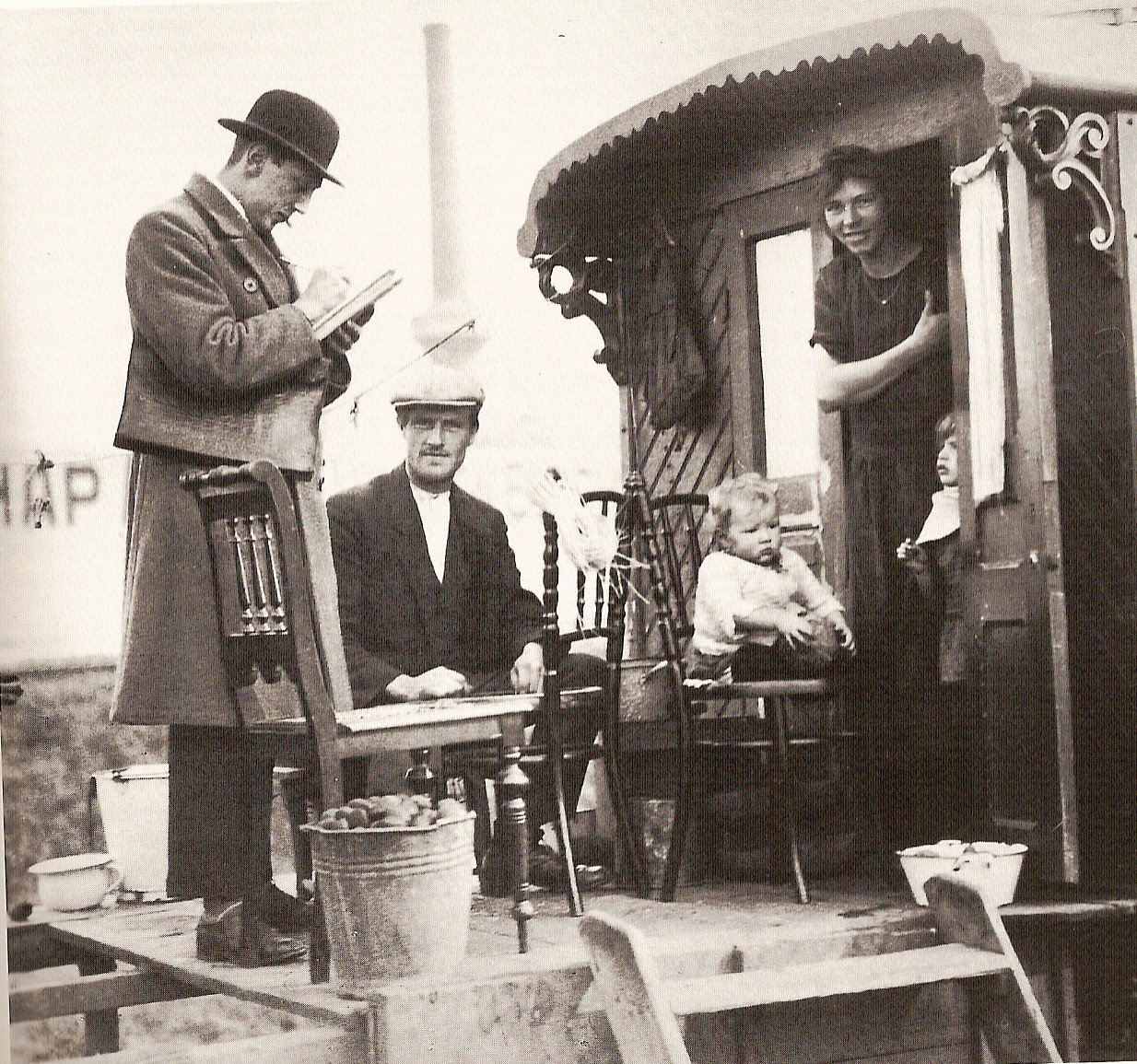
Flashback to My Ancestors in 1926


Census taker visits a Romani family living in a caravan, Netherlands 1925 from Wikipedia
Almost 93 years ago on June 1,1926,  a high of 12 degrees Celsius was recorded at Brandon but four days later a temperature of 25 degrees would have had my Manitoba ancestors working and playing in their shirt sleeves! Farmers all, they may have been annoyed at having to stop their daily activities to answer the questions of the visiting enumerator for the census but I am glad they complied!  Liberal William Lyon Mackenzie King was holding onto a minority federal government for just another month and Manitoba was led by premier John Bracken of the Progressive party. Hopes were high for another  large wheat harvest across the prairies and seeding would have been in full swing.

Back to present time - 2019 - my Twitter feed let me know that the database of the 1926 census of the 3 prairie provinces had just been released. Although the census was available earlier, there was no way to search for a particular name but you had to look page by page. Since 1871, a Canada-wide census has been held every 10 years. However, the population of the Prairie provinces was rapidly expanding, so there was a need for more frequent population counts in those provinces. It was decided to conduct a census of Manitoba, Saskatchewan and Alberta in June 1906 (in between the Canada-wide censuses), and every 10 years thereafter. The Statistics Act states that census returns will be transferred from Statistics Canada to Library and Archives Canada 92 years after a census has been taken so here we are.  The 1926 census database was created in partnership with FamilySearch where volunteer genealogists indexed the records to make them searchable.

Grandma Frances Milne is listed as 20 years old with her parents Alexander and Jean on 14-11-27 in the RM of Wallace with 3 of her brothers Alexander, Jim and Charlie and her sister Nan. The last 3 were noted as students.  The Milne’s are identified as Scottish with Alex immigrating in 1905 and Jean the next year.

Grandpa Frank Kinnaird would be married to Frances the next year but and in 1926  he is found as a 30 year old single man on the page before the Milnes. He lived at 1-11-27 in the RM of Wallace with his employee 48 year old Dave McMannus. A piece of information that I found interesting was that this census says both of Frank’s parents were born in Ireland when I believed they were born in Ontario. The census taker has indicated his racial origin is Irish. Hmmmm

Frank and Frances Kinnaird about 1927
Grandma and Grandpa Simms- Alexander and Mary Tait - are married and living on 15-14-22 with three of their children listed this way: Robt Alex (9), Doris Ellen (5) and Gwenny Elizth (2). Only a very few others on the page have middle names recorded by this enumerator (P.W. Thompson) so it makes me think it was Alex or Mary that gave the names that way. The surname is written "Sims" so evidently he was just writing what he heard.  The family was living in a small house built after the fire that destroyed their home on New Years Eve 1923. No doubt as they told Mr. Thompson the names of their children, they were thinking of Glenn James who had died at the age of two years old less than a year before.
Construction began on the Simms home a few months after the 1926 census was taken. 
 As seemed to be quite common in the area. Simms's have a labourer living with them of Polish origin named Joseph Bialas -19 years old and born in Manitoba. Neighbours on section 28, the Morcoms had a domestic living in their home, 17 year old Mary Bialas, perhaps the two were siblings or even a young married couple.
Above and left - Sinclair house and barn in the 1920's.

Mary Tait Simms's parents live on the next section #16, James and Elizabeth Sinclair with daughters Ellen (30) and Elizabeth(28) and son William(25). The year of immigration for James confirms he was an early prairie homesteader coming in 1883 from the Orkneys. His wife Elizabeth Henry was in Ontario much earlier, 1859 from Kirkcudbrightshire in Scotland.


Irving Shadford who identifies as Irish and William Vanderbosh of Dutch origin are labourers in their twenties living at the Sinclair farm in June of 1926.  

I hope I have interested you enough to go back and peek in the windows of your ancestors' lives.  They are just a mouse click away!

Wednesday, 6 February 2019

The Bankburn Star - December 21, 1907

Further to the last post about Bankburn School  , this tabloid school newspaper has survived the past 112 years fairly well and gives us a glimpse of the school and community though the eyes of the school pupils.  I wonder if there was ever a second edition or if this was the first and last. It is a wonder that it was printed on plain white paper, not newsprint, and the pictures were taken and reprinted so clearly.  Hope you enjoy reading it! 


Saturday, 2 February 2019

Bankburn School

It is always exciting to see a new comment on my blog and this week I received one on my Grandma Simms's post about a classmate of hers from Bankburn School. The school was located straight north of Oak River on the  Southwest quarter of 21-14-22 where a large bolder with an inscribed plaque marks the spot today. The Manitoba Historical Website has some information but I also have the following account written by former pupils, my great aunts.  

Memories of Bankburn School 1901—1917 
Written By Mrs. Lizzie Morcom and 
for the cairn dedication in 1984

In the year 1901 Bankburn School District No. 1098 was officially formed and the school opened with an enrolment of seven pupils. Bankburn School was built on a site overlooking the ravine which flowed through the farm owned by James Sinclair and his family. This farm was called Bankburn farm, so the school was appropriately named Bankburn. Mr. George Kelly of Pettapiece, Manitoba built the school which opened in August 1901. Classes had been held in James Sinclair’s granary in the summer months previous to the school being opened for a few years. We have James Sinclair, G. Sparling, and H. McPhaden to thank for being instrumental in having the “Bankburn District School” formed. Miss Ethel Sparling (Mrs. Walter Delamater) was the first teacher in the granary and also in the new school where she taught for two years before leaving to continue her studies.
The teachers through the years were as follows:
Miss Ethel Sparling (Oak River), Miss Annie Frazer (Hamiota), Miss Lizzie Shier (Hamiota), Miss Semima Cameron (Oak River), Miss Vivian Jackson (Rapid City), Miss Evelyn Spearin (Rapid City), Miss Mable Cooper (Souris), Miss Amanda Shields (Rivers), Mrs Islay Jackson (nee McIntyre) (Oak River).

The teachers boarded at Sinclairs, Sparlings, and McPhadens in turns. The highest salary received was $500.00 a year. Mother received $10.00 a month for room and board, washing, and ironing. A far cry from today’s prices.

The children that attended through the years have recalled the amusement they enjoyed when they knocked over the benches (accidentally on purpose) which were always the standard furnishings in the pioneer schools.


The second year Miss Cameron taught there were 42 pupils enrolled from Grade 1 through 8, 9, 10 and one studying for a third class certificate all had to go to Oak River and pay a sum to write and live there until the exams were all written (usually five days). What a thrill the teacher and pupils enjoyed when the report from the Department of Education came back—all had passed the exams clear with no supplements.

Many good times were held through the years at the yearly picnics, baseball games and football games, Box Socials through the winter months and of course dancing. The ravine was a big attraction in the fall and spring for skating and sledding. The Empire Day celebrations on may 24th honouring Queen Victoria’s birthday was an annual event. Maplewood School always came to Bankburn School for a baseball game. Miss Cameron had taught there before coming to Bankburn and she always arranged that game. After the ball game and programme, lunch was served by the parents. Rev McCullough, The Presbyterian Minister from Oak River, was chairman and Mr. Chris Cochrane, Reeve of Blanshard Municipality, gave a very interesting address on “The Flag” after which he raised the Union Jack which floated over Bankburn School for the first time. 


Sunday School was always held in the school every Sunday when a large crowd attended.

In the year 1917, a drastic change took place. Bankburn, along with Maplewood and Upland School Districts, were merged into the Oak River Consolidated School District ending the era of the three little “Red School Houses”. Some pupils were transferred to Oak River School by horse drawn vans—winter and summer. The taxes at the time were $42.00 a quarter.

Bankburn School was later sold to John (Jack) Andrews and moved to his farm which later became the property of W. D. Reid and son Bill. Eventually the former Bankburn School became the property of Murray Kirkpatrick. A cairn has been erected on the site where the Bankburn school stood. On Sunday, July 15, 1984, a dedication will be unveiled in the memory of the pioneers who were instrumental in having the school built, teachers, pupils, trustees and Secretary Treasurers.


The students who attended from 1901—1917 were as follows:
Mary Sinclair Ralph Espey                                Jennie Lee
Jean Sinclair                                 Ada Espey                                     Annie Lee
Nellie Sinclair Janet McKenzie Pearl Lee
Lizzie Sinclair  Katie McKenzie Frank Hyndman
Alex Sinclair Eddie McKenzie Annie Hyndman
Bill Sinclair                                  Bessie McKenzie Ralph Hyndman
Clara McPhaden Rosie Day                                     Rae Armstrong
Barclay McPhaden Herbie Day                                    John Warren
John McPhaden Fred Smith                               Marjory Thompson
Frank McPhaden Hilda MacLay                          Joshua Thompson
Myra McPhaden Russell Bayman Alex Thompson
Percy McPhaden Laura Ireton Norah Thompson
Cedric McPhaden Delbert Glazier Harry Thompson
Marjory McPhaden Earl Glazier                                     Laura Smith
Morton Furtney Tory Furtney                                   Frank Smith
Bella Furtney                                  Bill Reid                                         Harry Smith
Hubert Sparling Jack Reid                                     Mildred Reid
Muriel Sparling Sadie Reid                                       Eddie Reid
Ena Sparling Margaret Reid                                Gladys Reid
Elmer Sparling Myrtle McQuaig Pat Reid
Herbie Davis                                   Wilf McQuaig                                George Reid
Lorne Davis                                     Roy McQuaig                        Harvey Robinson
Arthur Davis                                    Elsie McQuaig Seaman Robinson
Harry Davis                                      Pearl McQuaig Lawrence Robinson
Jim Davis                                          Elsie Davis                                     Eva Davis

Although all those who taught and attended Bankburn School have passed on, it lives on in the ways each and everyone of these people touched the lives of others.

Keep reading my next post here for more on Bankburn School. 

Sunday, 13 January 2019

William Ollett (1838-1922)


Although the subject of this week’s blog post is not a direct ancestor, William Ollett has an interesting story.  Aunt Dodie helpfully labelled the above picture in the 1959 Blanshard History book and the Ollett biography in it is the main source of my information. As well, this Rootsweb site included his obituary from the Oak River Post in 1922, part of which is below. Two of William and Ann Ollett's grandchildren were the subject of previous blog posts: Å amuel Robert Henry and Jessie Henry Sinclair .  Their mother was Amelia Ollett Henry, called Millie, who was the daughter of this William.

In 1881, while Millie's future husband's family was homesteading the prairies of Manitoba, the Ollett family lived in Gelligaer, Glamorgan, Wales where William was described as a Railway Platelayer on the census.  He and his wife Ann Fletcher had a family of 7 children, 3 boys and 4 girls. Five years later, 48 year old William made a daring decision to leave Wales and join the flood of immigration to Manitoba.  His youngest daughter Millie, then 13 years old, accompanied him on this adventure throughout parts of Manitoba building the railway before Ann and some of the rest of the family joined them in 1888.  His experience in Wales helped him become foreman of a gang building the railroad from Brandon west.  He had also been a gardener as in Wales so the story goes that he planted trees all along the way in places he lived.  William helped open up Canada's west and beautified it too!

Daughter Millie worked first in Headingly and then once her mother arrived, they ran a boarding house at Gautier Junction just two and a half miles west of Rapid City on the CPR line. (The location of this spot on the Little Saskatchewan River was identified using the memoir written by Charlie Mundell in the Rapid City History Book.)

In 1899, Millie moved to the next stop on the line at Pettapiece to work in the store.  It was about this time that the Ollett men, William Sr, William Jr, James and Robert decided to try their hand at farming and bought land southeast of Floors Siding.


Robert married a daughter of the neighbours John and Jennet Henry, Mary in January of 1903 while William and James always remained unmarried. Robert and Mary had a family of 5 - 3 girls and 2 boys and lived at SE 27-13-21, I believe. Three months after Robert and Mary, March 11, 1903, Amelia Ollett married Samuel Henry, sister of Mary. Millie seems to have chosen a tamer brother as two of Samuel's brothers, Charles and Joseph, made the headlines of the papers at least 3 times in 1887  , 1896 and 1898 before their premature deaths as told in previous blog posts.  Millie and Samuel had a daughter and then 3 sons and farmed the homestead farm across the road from Robert and Mary Ollett at NW 22-13-21 (pictured above) except for a short time in Rivers where he built and ran a livery stable.

From the Oak River Post, Oak River, MB1/11/1922 WILLIAM OLLETTThe death occurred on Thursday, January 5th, at his home near Pettapiece ofWilliam OLLETT at the advanced age of 84 years and 25 days. The late Mr.OLLETT came to this country from Wales about thirty-four years ago. Heacted as caretaker of the Oak River station during the interim between thecompletion of the road and the running of the first train. Later he wassection foreman and ran a boarding house at Gautier Junction. About twentynine years ago he homesteaded the farm on which he died. He remained welland hearty until a few months ago but appeared to be feeling better thanusual when the end came, without pain and without warning, as he sat in hischair after having eaten his supper.

Samuel Henry died in 1947 and Millie followed 10 years later.  Samuel and Millie's stone is pictured below in The Oak River Cemetery.  Millie lived at home with her son Sam and his wife Doris.  I have Aunt Dodie's diaries from that time and she always refers to her as "Mrs. Henry" in them. I am guessing that Millie Ollett Henry would have seen many changes since her youth in Wales but held onto the formalities of days gone by.

William's wife Annie Ollett died in February of 1926 at the age of 88.  The Ollett men are named on stones at the Pettapiece Cemetery.   The name may be gone from the district but I hope that one of the descendants stumbles over this blog post someday and finds out what I have gathered on the Ollett's time here on Earth and the legacy they have left to those who follow.

Tuesday, 1 January 2019

James Rae (1894-1966)

Two previous posts about Peter Deans Rae here and here, got me interested in the story of his younger brother James. He had been identified by my Aunt Dodie in the picture below on the left with Pete. It was rather puzzling however to hear from a Rae relative overseas that James had died in WW1. I wondered how Dodie would have know who it was when she was born in 1921.


A little digging online found the WW1 attestation papers for James Rae with Regimental Number 700418.  (There were at least 20 other men with the same name in the Library Archive Canada database of Canadian Soldiers.  It makes me realize the monumental number of files they had to digitize during the project.) 


Volume 2 of the Blanshard Municipality History book written in 1970 says James left Galashiels, Scotland some time after his brother Pete did in 1910.  He worked for farmers around the Oak River area until enlisting in WW1 just before Christmas on December 23, 1915 when his current address was 438 Hampton St in St James now Winnipeg.  According to the history book, he saw service in France with the 43rd Cameron Highlanders.  

The online personnel files fills in a few details for James but also gives but a glimpse of the terrible experience it must have been for him.  He was no stranger to the hospitals overseas and the combined effect of his injuries and illnesses would have left him a changed man.  After his enlistment and during his training at Camp Hughes, Jim contracted diphtheria in April of 1916.  Although hospitalized in Winnipeg, two months later he was well enough to set sail on board the Olympic for England.  In October of 1916 he is admitted to hospital for gun shot wounds to his arm and as a result he lost his left index finger up to the first joint.  He was admitted again in November for influenza.  In April of 1917, James is docked a day's pay for the neglectful loss of  equipment - his helmet. June 30, 1917 he received gunshot wounds to both legs.  Continued x-rays and removal of pieces of shrapnel are documented over the next few weeks until his wounds are declared "practically healed" by the end of July. 

Notable in his file is a notation that be refused to make a will dated October of 1918. I wonder if he thought by the time he had lived through that much, there was no need to make out a will! On his discharge in March if 1919, he stated he intended to make his home at Oak River. Twenty dollars was sent to his mother Elizabeth in Scotland as support each month he was on duty.
  
After the war he worked for a Henry connection of mine, Charles Henry among others. The history book goes on to say he became ill with sleeping sickness and remained in poor health for several decades until his death at age 71 on January 25, 1966.  His mother Elizabeth came to Canada to live near her sons in the early twenties and perhaps it was due to James needing more care than Pete could supply.  A note from Veterans Affairs appears in his personnel file that James died on January 25, 1966 at the Hospital for Mental Diseases in Brandon.   There is no evidence but I wonder if James suffered from the following condition as described in Wikipedia.
Encephalitis lethargica is an atypical form of encephalitis. Also known as "sleeping sickness" or "sleepy sickness", it was first described in 1917.
The disease attacks the brain, leaving some victims in a statue-like condition, speechless and motionless. Between 1915 and 1926, an epidemic of encephalitis lethargica spread around the world. Nearly five million people were affected, a third of whom died in the acute stages. Many of those who survived never returned to their pre-existing "aliveness".
Although not one of my blood relatives, James Rae deserves to be honoured and remembered for his part in fighting under Canada's flag and being a friend and neighbour to my ancestors.  He is buried with a soldier's headstone in Oak River Cemetery alongside his mother Elizabeth.  Rest in Peace, James.

Sunday, 1 April 2018

Easter Greeting Postcards

The three Easter postcards on today's blog post come from the collection of my dad's Aunt Elizabeth (Lizzie) Sinclair Morcom. It seems these greetings began at the turn of the century but after WW1 they were in their heyday.


Only one has writing on it and that identifies that it predates her marriage in 1930.  Her nephews, the little Fortune boys were born in the early twenties and  are the little boys in the picture below on the Sinclair house steps. Their little sister Irene, born in 1925 is being held by Nannie, their mother Jean is in the black tie.  Lizzie (with the glasses) and Jessie are on the right side.


The picture above shows Lizzie is sitting on the same steps with her brother Bill.  My sister Janice and I have said his wild hair gene may have been passed down to her son!  The postcard that appears to be in a car has Lizzie at the back (in the glasses), Nellie holding Irene but I'm not sure of the other two sitting in the front seat.  Hopefully my blog readers can help me identify them!

Happy Easter!


Saturday, 17 March 2018

Arcade Cards

These arcade cards from the 20's and 30's were found among the belongings of Harry Clyne and before they were sent off to a niece in Scotland with his other prized belongings, I scanned them and finally got around to doing a little research. Arcade cards like these were postcard sized and were sold in amusement parks in the US and Canada and thus their name.

Bud Baer was a boxer in the 1930's who also acted on television and in films.  His nephew, Max Baer Jr. , became famous for his role as Jethro on the Beverly Hillbillies in the 60's. A copy of the same photolithograph can be found in the collection of the Metropolitan Museum of Art  in New York City.  He died in 1986 and is buried in California.


Harry Carey was the lead actor in the silent film Burning Bridges that was released by Pathe Exchange Inc in 1918.  During this time, Carey grew into one of the most popular Western stars of the early motion picture, occasionally writing and directing films as well. Carey would appear in at least 233 films, including short features, between 1909 and 1949.

Rex Lease and Tim McCoy acted in The Masked Stranger, another silent movie. 
From the 1928 film "Beyond the Sierras".

 The machine that these cards were dispensed from were like the one below from the Exhibit Supply Company of Chicago  for a penny or two.


Harry kept these arcade cards with his family photos and I wonder what memories they held for him of the place he got them or the person who gave them to him. I'm just glad he kept them.
Henry "Harry" Clyne - 1950's


Saturday, 24 June 2017

The Sinclair House


The recent photo above, taken by Richard Turenne and posted on the Abandoned Manitoba site on Facebook, brought back many fond memories for the Sinclair nieces and nephews including me!  What a mansion I thought it was and by any standards, it was a magnificent home for the James and Elizabeth Sinclair family.  It was built in 1912 and the picture below may have been from the 20's.


One tall brick chimney let smoke rise from the cookstove and the other from the fireplace in the parlour. A verandah wrapped around the south and east side of the two and a half story home for the family of 8 children.

The east side of the verndah was made into an enclosed porch by Harry Clyne after the above photo was taken and I remember John Paul (Scotty) and Harry sitting in here smoking their pipes when I would come for a visit.  Inside the kitchen to the right was a washstand with a hand pump for cistern water and straight ahead was the "back stairs" to the second floor.  A huge kitchen table, cupboards, counter, an electric and a wood stove, fridge and the cellar door filled the kitchen.  There was no running water in the house but drinking water was brought from a well near the barn and the outhouse to the north served them for all those years.

A doorway led into the dining room and that followed into the parlor, with the fireplace.  Beyond that was one bedroom on the main floor and the wide main stairs led up to six more bedrooms. A small balcony was outside the door at the south end of the second floor but it's now gone.

Another narrower staircase with an oak banister went up to the half story attic on the top floor with two dormer windows for light.  The attic level was likely used for sleeping quarters at one time, perhaps for hired men at harvest time. My dad recalls a hatch from the attic to get to the widow's walk on the top the house and Uncle Bill would go up there to put up Christmas lights.  The view of the Oak River to the south must have been spectacular!


The picture of little great great niece Kim standing in front of the huge vegetable garden was taken about 1977 and the one of Aunt Nellie and Aunt  Jessie in front of their flowers and the woodpile was in 1981.  Notice the 106 foot long barn (built in 1900) propped up on the north side as Dad recalls it was for many years.  It seems the wall may have weakened from the chaff pile being blown against it from the threshing over the years. 


Left above:  Elizabeth Sinclair on the verandah with twin grandchildren Dorothy & Donald (my dad) Simms 1933, 
Photo on the right:  Jean Fortune, Bill Sinclair, Mary Simms, Nellie Sinclair and Lizzie and Jack Morcom - about 1955 in the doorway between the dining room and the parlour.  Note the wide woodwork.


Left:  Lizzie and Jack Morcom in front of the fireplace in the parlour early 50's,
Right:  Aunt Nannie on the verandah - 1940's

Jean Fortune (with black tie) and her children - Kenneth, Arnold and Irene. Nellie holding Irene and Lizzie (with glasses) and Jessie in matching dresses on the south verandah steps - about 1927
Left:  Jessie and Nellie Sinclair in the kitchen in front of the cookstove and cellar door - 1967
Right:  Bill and Jessie Sinclair on the south steps - 1940's

The Sinclair house and grounds were lovingly maintained by the ladies well into their 80's. New Year's Day was a special event in the Sinclair house for many years with the family all gathering to visit and eat!  I remember playing on all the coats (especially the furs!) on Aunt Nannie's bed. Another fun memory shared by a cousin was of running up one staircase and down the other in a never ending circle!  The last the house was lived in was 1988 but the memories remain.  Richard Turenne's picture on the post on Facebook received 250 "likes" and 54 "shares" and has made me proud to be connected to this piece of history.