Print Friendly and PDF
Showing posts with label Henry. Show all posts

Sunday, 13 January 2019

William Ollett (1838-1922)


Although the subject of this week’s blog post is not a direct ancestor, William Ollett has an interesting story.  Aunt Dodie helpfully labelled the above picture in the 1959 Blanshard History book and the Ollett biography in it is the main source of my information. As well, this Rootsweb site included his obituary from the Oak River Post in 1922, part of which is below. Two of William and Ann Ollett's grandchildren were the subject of previous blog posts: Ć amuel Robert Henry and Jessie Henry Sinclair .  Their mother was Amelia Ollett Henry, called Millie, who was the daughter of this William.

In 1881, while Millie's future husband's family was homesteading the prairies of Manitoba, the Ollett family lived in Gelligaer, Glamorgan, Wales where William was described as a Railway Platelayer on the census.  He and his wife Ann Fletcher had a family of 7 children, 3 boys and 4 girls. Five years later, 48 year old William made a daring decision to leave Wales and join the flood of immigration to Manitoba.  His youngest daughter Millie, then 13 years old, accompanied him on this adventure throughout parts of Manitoba building the railway before Ann and some of the rest of the family joined them in 1888.  His experience in Wales helped him become foreman of a gang building the railroad from Brandon west.  He had also been a gardener as in Wales so the story goes that he planted trees all along the way in places he lived.  William helped open up Canada's west and beautified it too!

Daughter Millie worked first in Headingly and then once her mother arrived, they ran a boarding house at Gautier Junction just two and a half miles west of Rapid City on the CPR line. (The location of this spot on the Little Saskatchewan River was identified using the memoir written by Charlie Mundell in the Rapid City History Book.)

In 1899, Millie moved to the next stop on the line at Pettapiece to work in the store.  It was about this time that the Ollett men, William Sr, William Jr, James and Robert decided to try their hand at farming and bought land southeast of Floors Siding.


Robert married a daughter of the neighbours John and Jennet Henry, Mary in January of 1903 while William and James always remained unmarried. Robert and Mary had a family of 5 - 3 girls and 2 boys and lived at SE 27-13-21, I believe. Three months after Robert and Mary, March 11, 1903, Amelia Ollett married Samuel Henry, sister of Mary. Millie seems to have chosen a tamer brother as two of Samuel's brothers, Charles and Joseph, made the headlines of the papers at least 3 times in 1887  , 1896 and 1898 before their premature deaths as told in previous blog posts.  Millie and Samuel had a daughter and then 3 sons and farmed the homestead farm across the road from Robert and Mary Ollett at NW 22-13-21 (pictured above) except for a short time in Rivers where he built and ran a livery stable.

From the Oak River Post, Oak River, MB1/11/1922 WILLIAM OLLETTThe death occurred on Thursday, January 5th, at his home near Pettapiece ofWilliam OLLETT at the advanced age of 84 years and 25 days. The late Mr.OLLETT came to this country from Wales about thirty-four years ago. Heacted as caretaker of the Oak River station during the interim between thecompletion of the road and the running of the first train. Later he wassection foreman and ran a boarding house at Gautier Junction. About twentynine years ago he homesteaded the farm on which he died. He remained welland hearty until a few months ago but appeared to be feeling better thanusual when the end came, without pain and without warning, as he sat in hischair after having eaten his supper.

Samuel Henry died in 1947 and Millie followed 10 years later.  Samuel and Millie's stone is pictured below in The Oak River Cemetery.  Millie lived at home with her son Sam and his wife Doris.  I have Aunt Dodie's diaries from that time and she always refers to her as "Mrs. Henry" in them. I am guessing that Millie Ollett Henry would have seen many changes since her youth in Wales but held onto the formalities of days gone by.

William's wife Annie Ollett died in February of 1926 at the age of 88.  The Ollett men are named on stones at the Pettapiece Cemetery.   The name may be gone from the district but I hope that one of the descendants stumbles over this blog post someday and finds out what I have gathered on the Ollett's time here on Earth and the legacy they have left to those who follow.

Monday, 17 October 2016

Henry Brothers in the News - Part Three

Now - the final tale of the Henry brothers that were involved in the 1877 shooting of an aboriginal man as detailed in this blog post.  Joseph's (1857-1896) end came with a shotgun blast from a short tempered 20 year old Arthur Gerhold as written about here.  Today's post tells of the death of Charles Henry and resulting legal proceedings as it was reported in the newspapers papers of the time.  Aunt Dodie's notes about him refer to him as " Red Charlie" so as to distinguish him from his cousin Charlie.  

Charlie was born the 24th of October in 1862 in Listowel, Ontario.  He came west with his family at the age of 16 and according to family history, took out several pre-emptions before homesteading on SW 22-14-22 in April of 1892. (This was my Uncle Bob and Aunt Margaret Simms' farm home when I was growing up.)
 
Interestingly, paperwork for a $500 mortgage with The London and Canadian Loan and Agency Company Limited on the original John Henry farm at W 22-13-21 from September of 1884 was found among some Henry papers. Charles had a handsome signature which I assume indicates an education in Ontario.


On February 25, 1885, Charles had married Fanny Sarah Cleaver (daughter of Thomas Cleaver and Katherine McNeil) at the manse in Oak River.  Charlie and Sarah became parents to Ida Ethel (b 1887), Viola May (1890), Percival Albert (1892), John Thomas (1895), Roy Elmer (1896) and Leslie Hilmger (June 1898).  Another son Harvey Harold Cleaver was born in January of 1899.

The story goes that on July 4th 1898, Charles, Alex Miller, Ab Hayes and  R. Cornborough  went to see the Lemen Brothers Circus in Rapid City. The main attraction at this circus was apparently Rajah, claimed to be the largest elephant that ever walked the earth.  Tom, the boxing kangaroo along with the "Monster Show" made the tour of Gladstone, Birtle, Yorkton, Russell and Neepawa as well as Winnipeg that summer.  The Portage La Prairie Weekly August 11, 1898 edition reported:
Several parties who were to see the Lemen Bros. Circus at Rapid City came back disgusted.  They report swindling and gambling the order of the day.  
Ironically, swindling and gambling would have been much better than the fate that awaited Charlie that day.  Arriving too late to see the circus, the men decided to make the rounds of the local hotels and began drinking.  Newspaper accounts say between 9 and 10 o'clock that night words were exchanged and then fighting began with some Rapid City boys.  Charles was hit on the head with a club or pole as part of the melee.  Thomas Cleaver (perhaps his brother-in-law?) was also stabbed in the back with a penknife while trying to come to the aid of the Oak Riverites.  After the fight broke up, Henry and two of his friends loaded up in the wagon and headed for home.  Somewhere on the road home, his companions noticed he was unresponsive and that Charles died.  They rushed him to Oak River where the Dr Jackson declared him dead and found a blow to the base of his skull to be the cause.


Found on Newspapers.com

Investigation into the event began and Charlie's sister Jessie Henry, who worked at a hotel in Rapid City, claimed she overheard a man admit to her boss that he had delivered the fatal blow.  At the Fall Assizes of 1898, Christopher Stewart of Rapid City, the accused, pled not guilty in the death and Miss Henry's boss denied Stewart had ever confessed to her.  In the end, he was found not guilty of manslaughter. Witnesses said the man who struck Henry ran after him into the mill pond but the doctor who treated Stewart that night testified his pant legs were not wet while tending a wound on his knee 30 minutes after the fight.

Thirty-five year old Charles Henry was buried at White Bank Lea Cemetery, not far from his homestead.  In 1907, his widow and her five surviving children moved to Dauphin. The youngest two sons had also died in the meantime, compounding her grief and hardship.  Sarah passed away in Dauphin on August 18, 1926 at age 61.

It has been most interesting to me to research these three stories.  The style of blunt and graphic writing in the local papers in the early days of western Manitoba is fascinating.  Fellow Henry researcher Mary Bole intrigued me about them in her book called the Henry History written in 1998. Newspapers.com offers a seven day free trial.  Try it - you never know what you might find...


Thursday, 13 October 2016

Henry Brothers in the News - Part Two

Following his not guilty verdict for manslaughter in November of 1887 as detailed in this blog post, Joseph Cook Henry went about his life out of the newspapers for the next nine years.

He had earlier returned to his former home in Perth, Ontario to wed Mary Purdon on the 2nd of March in 1886.  Joseph was 28 years old at the time of his marriage and Mary was 30. He had come to Manitoba to homestead at the age of 22 and may have finally felt ready to bring a bride to the west at that time.  They had a daughter named Janet Barbara (known as Jennie) in August of 1887, and their lives would have been hard and full of dangers.  The Manitoba Free Press clipping from October 14, 1887 reported from the preliminary trial;
It appears that Joseph Henry's family had been forced for some nights to leave their own home on another section, and take refuge in the home of Mr. Henry, sr., being in constant dread of the Indians.  The evening before the shooting the Indians had endeavored to break into the house of Joseph but could not.  At the first opportunity the family left.  After the shooting, Joseph visited the house and found that it had been ransacked.  There were five witnesses examined and their evidence was corroborative of the above.  
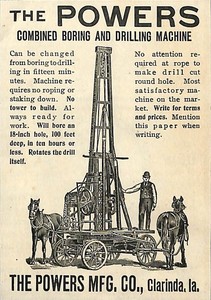
Joseph's father, John Henry Sr., had died in September of 1888 but his sons carried on farming and building up their farms.  In the 1891 census, Joseph's  family of three was living in the Rapid City subdistrict with 22 year old Duncan L. Purdon, maybe Mary's brother. As a homesteader, he would have searched out other sources of cash income to make up for crop failures and lack of markets for what he did produce.  Joseph became the superintendent of local government well boring machine number 4, perhaps like the one pictured below.  In mid August of 1896, fate found the 39 year old drilling a well on a farm belonging to David Jackson on 6-15-20, five miles straight east of present day Cardale on Road 355.


On the 17th of August in 1896, Joseph again makes the newspapers in this graphic account of his violent death.

Found on Newspapers.com

This website has gathered all the newspaper accounts of the day and says that Arthur Gerhold had come to Canada from England with the "Sailing Alone" program in June of 1893 at he age of 17 and worked on the Jackson farm for $135/year.  Although some accounts of the time call him a Bernardo boy, this does not appear to be the case but the Sailing Alone program seems similar in nature - giving a new start in Canada to poor boys and girls from England.  Arthur was said to have made a full confession of killing Joseph to the police constable who transported him from Rapid City to Brandon and did the same in a letter to his parents back in England.  This letter was intercepted by the prison guards and although challenged, it was admitted as evidence against him at his trial.
Dear mother and father--Just a few lines to let you know of the trouble I am in now. Last Monday morning I had a quarrel with a man that has been at Mr. Jackson's boring for water in which I shot him. We had another last Saturday afternoon in which he was pretty near laying me out and he started again at me yesterday morning in which I settled him.
Do not be down-hearted to hear of this news. I am here waiting a trial, forty miles from Jackson, my late boss. I will let you know the verdict if you don't happen to hear it through the papers. It will be a case of manslaughter in which it depends upon the juries verdict whether I get off easy or not.
It is a bad thing to happen, but I could not help it. I was in a bad temper when it happened. Do not worry. I thought I had better let you know. I will write again if possible, so cheer up. With kind love to all and yourselves, good-bye. From your faraway son, (Arthur.)
The trial of Arthur Gerhold took place in front of a judge and jury in Brandon a few months later at the Fall Assizes.
Winnipeg Free Press - November 19, 1896

This afternoon Dr. Crookshank, of Rapid City, a practitioner of medicine of that place, was the first witness called, and he testified to having been called to view the body just after the murder. He said that he had examined the wound which caused Henry's death. ... The deceased was personally known to him and he was of the opinion that deceased would be a true friend, or if antagonized he could be, and would be, a bitter enemy. He was the coroner who sat on the inquest, which inquired into the death of the Indian that Henry had been arrested and acquitted on the charge of murdering.
The jury failed to agree on a verdict and a new one was called. (I presume their difficulty was whether this was a case of murder or manslaughter, not whether he was the one responsible.) The second jury found Gerhold guilty of manslaughter and the judge sentenced him to 20 years at Stony Mountain.  He was released from prison in 1911 and moved to Massachusetts where Arthur Gerhold married and had a family.


Joseph was buried in the Henry family plot at the Rapid City Cemetery.  His widow Mary and daughter Jennie were living in Brandon according to the 1901 census and in 1916, Mary was with Jennie and her husband George Abra in Neepawa.  She later moved east with them where they were in Kitchener on the 1921 Canadian census.  Mary died in Niagara Falls in 1942.

There is one more tragic chapter in this tale concerning Charles Henry, not this one but his cousin Charles.  To be continued...

Tuesday, 11 October 2016

Henry Brothers in the News - Part One

My great grandmother Elizabeth Henry Sinclair, grew up with 10 siblings and 11 other Henry cousins in the Perth area of Ontario in the 1860's and 70's. As the boys grew and were looking to acquire land of their own, her Uncle John and Aunt Jennet and family made the move west to Blanshard Manitoba in 1879 and the Widow Mary and her brood followed in 1881.  Times were tough by all accounts but newspaper articles from the time I've recently found bring home that point even more.  Rather than judge the Henry boys for a wild and rough lifestyle, I prefer to marvel at their resilience and be thankful my life and times are so much kinder and gentler.

In October of 1887, the Manitoba newspapers are full of stories about so called "Indian Troubles" in the west. The Northwest Rebellion was a short 2 years past and the following article was found in the Manitoba Free Press on Monday, October 10, 1887.


Found on Newspapers.com
 
Four days later the same paper has more details about the incident under the understated heading "A Little Unpleasantness Between the Indians and the Settlers at Rapid City"
The Henry family, comprising of father, mother and several sons, live on adjoining sections some miles west of Rapid City and are among the most peaceable and law abiding citizens in that country.  Last year the Henry's had all their crop destroyed by fires, started they were almost certain by Indians.  They had not enough left to keep them in food during the winter. This year a large crop was put in and harvested, and a considerable quantity of hay put up.  Fire guards were run around the stacks, and every precaution taken to prevent fire.  On Tuesday of last week, however a 40 ton hay stack some distance from the house was seen to be on fire and an Indian (the one subsequently shot) passing in its neighborhood. That the stack was not burned by prairie fires was evident from the fact that outside the fire guards the prairie was unburned.  This gave the Henry's reason for being alarmed and at once they set out to defend themselves and their crops.  The following day, Wednesday, fire was seen approaching their wheat stacks from the neighborhood of the Indians' camp.   Mr. Henry Sr immediately started for the endangered stacks and on reaching them found an Indian seated at the base of one, scratching something as if about to strike a match. On the arrival of Mr. Henry, the Indian ran, sprang over a fence and left the vicinity.The next morning, Thursday, Joseph, son of Mr. Henry, started out on his pony and had not gone far before he met the Indian that they had suspected was in a ravine near the house, causing them so much trouble.  He ordered the Indian away but he would not go. Hearing the conversation the old man told Charles to go down and take the gun with him to frighten the Indian.....
Of course you know much more resulted than his being frightened and the body was taken charge of by the reeve of the municipality, a Mr McCallum, and placed in a granary on a Henry cousin's farm.  An inquest was to be held but the granary and body were set fire to and destroyed by unknown persons.  Joseph and Charles were then arrested and taken to Brandon.  An old friend of their father's, Mr. Martin from Portage La Prairie, was sent for to defend them.  Some courtroom drama ensued and the charge against the brothers was changed from murder to manslaughter.  After paying bail of $1000 each, they were home that evening to await their trail at the Fall Assizes in a month's time.
  
It is incredible to think the name of the victim was never known, or at least reported.  The language used showed the reporter's bias toward the settlers The brothers were acquitted of the crime by jury as you can read about in this link.  https://www.newspapers.com/clip/6827037/henry_brothers_aquitted/

It is an incredible story on its own but the ironic part is both Henry brothers involved - Joseph and Charles - will come to their own unexpected and violent deaths within the next 11 years.  Stay tuned dear readers...

Friday, 16 September 2016

Our People

The phrase "Our People" reminds me of my Aunt Dodie and Great Aunt Nannie. It is an expression I remember them using when they talked about anyone connected to the Widow Henry's connections. I don't suppose they were the type of people to intend to exclude others but it reminds me of another description of theirs for the Henry's - we come from "Good Stock".   It was 35 years ago this past summer when a Henry Reunion (program below) was held in Oak River which included over 250 descendants of Mary Tait Henry.


It is amazing to think that 3 generations back, all but 2 of Mary's 10 surviving children lived in Blanshard Manitoba within a few short miles of her.  Daughter Ellen Turriff lived at Rapid City,  some 30 kilometres away with her family and Mary Wilson was further afield at Gilbert Plains.  Her sons Ned, Charles, ThomasWilliam and Jack homesteaded adjacent quarters and daughters Elizabeth and Janet and Joanna married neighbouring farmers and raised their families close to home. Keeping up on the lives of "Our People" was important to them with many hours spent visiting and no doubt writing letters back and forth.

My recent connection with one of "Our People" makes me realize how far the Henry descendants are spread across the world today.  At his home in Nagasaki, Japan while searching his mother's name, Brian Burke-Gaffney came across my blog page here about his maternal grandparents.  Their young tragic deaths is one of the saddest stories I've uncovered in my family history research.  The post included a photo of Hubert and Janet Sparling's gravestone at White Bank Lea Cemetery, just across the road from the original home of his 2nd great grandmother Mary Henry, also the resting place of his McKenzie great grandparents. After his comment on the blog, my sister Donna remarked how small the Internet has made the world today and I must agree. 

Brian was kind enough to send along the picture below of his mother Elizabeth Jane (Beth) and her older sister Leila Sparling, orphan daughters of Janet and Hubert Sparling.  Beth was raised by her Mother's sister Elizabeth Ismay McKenzie - known as "Bessie" and her husband Frank McDonald.  Frank and Bessie married in 1925 and farmed just south of Oak River on 22-13-22.  They had one daughter of their own, Thelma. After leaving Oak River in the late 30's, Beth went to business college in Winnipeg and began working for the CBC.  She met John Burke-Gaffney and had three sons before succumbing to cancer in 1981 at the age of 58.


Beth and John's middle son Brian had never been to Oak River before taking a detour into town in 2002.  With the help of a friendly storekeeper and relatives including his mother's cousin Gerry, Brian was shown around his grandparents' former neck of the woods.  I hope he left with the feeling that he is one of Our People and always will be.
  

Tuesday, 12 July 2016

180 and 160 Years Ago Today

The Ancestry app on my phone came in very handy again when it told me that it was 180 years ago today - July 12, 1836 - that Mary Tait, my 2nd great grandmother was born in Scotland.


What I did not realize before was that her daughter, my great grandmother Elizabeth was born the same day, exactly 20 years later in 1856 in Troqueer, Scotland.  Mary and her husband William Henry left Scotland with baby Elizabeth for a new life in  Canada two years later. The photo below of William and Mary was taken in Perth County Ontario in the mid 1800's.


After the birth of 11 children and the death of her husband, Mary and her family left Ontario to homestead on the open land in Manitoba in 1881.  Elizabeth went on to marry local homesteader James Sinclair and have a large family of their own.  


July 12 - a date to remember in my family tree!

Wednesday, 13 January 2016

John "Jack" Henry (1868-1958)

John Henry was born in Ontario on the first of March in 1868 to Mary Tait and William Henry, the final sibling to be written about in this blog.  They farmed in the Listowell area of Perth County until his father died when he was 10 years old and they headed west to Manitoba when he was 13 in 1881. They lived near  a Blanshard Township in Ontario so moving to Blanshard, Manitoba must have been a small comfort to the Henry family.   His mother and his 10 siblings then settled on SW 6-14-21. He was more commonly known as "Jack" likely to distinguish him between an uncle and cousins with the same first name. The adjective "sixes" was also used to refer to this family and home as it was on section six.

Jack acquired NE 1-14-22 just west of the homestead in 1898, not including the portion where the White Bank Lea Cemetery sits.  It would have been suited to crop more than the hilly land with a ravine where the house was.

He remained on the home farm after his mother's death in 1909.  He married 26 years old Winnifred Theobald Frost Delamater in 1912 at the age 44 and went on to have nine children, six sons and three daughters. 
  • Lorne "Homer" (1913-2001) remained a bachelor worked the home farm and was active in community affairs and committees
  • William "Orville" (1914-1976) married Betty Reid, farmed the home farm
  • Alexander (1916-1980) married Effie Reid (sister to Betty) and raised 5 children.  Farmed the former Hedley homestead (NW 30-13-21) and other quarters with Esmond, worked at Murray's Garage in Oak River and served in WW2
  • Robert Thomas "Bob" (1918-1993) remained a bachelor on the home farm and was sports minded
  • Mary Ellen (1919-1987) married Donald James Moar had 4 children and lived in Brandon
  • Walter John "Watty" (1921-1986) remained a bachelor and enjoyed company and home life on the home farm
  • Rena (1922-) married Allan Reid (brother to Betty and Effie) and had 2 sons, lived on the home farm with her brothers and is the only surviving member of this generation of the family - living in Oak River today
  • Edmond Frank (1923-1980) remained a bachelor, served in the army with Alex then farmed with him east of Oak River
  • Laura (1927-2005) married Herb Stephens and farmed near Cardale and had five children

Jack was one of the original members of Oak River's first organized baseball team which was coached by his cousin, his mother's sister Ellen's son, Tom Wilson.

 The White Banklea History Booklet written in the 1980's says of Friday night dances at the school near the Henry farm:
Local music was provided by the people of the area.  Alex Stewart and Mrs. Dick Stewart provided the early music at White Bank Lea.  Later Maurice and Dot Genung, Elgin and Harvey Stewart supplied the tunes to which they danced.  Square dances were very popular and Jack Henry from the "Stone House" was known as the official caller.  Everyone enjoyed the seven step, the scottiche, the buffalo glide and the French minuette.  The waltz was always popular and in later years couples danced to the newer dances known as the fox trot, two step and one step.  Lunch was always supplied by the ladies, an on occasion this was in the form of an old time Box Social.  
Jack (with the corsage at the back left) on the occasion of his 80th birthday in 1948.  Beside him, brother Thomas (79 years old), Ned (86) and Charlie (82).  In front left to right -  sisters Joanna Braid(72), Janet McKenzie(88) and Mary Wilson (74).
He passed away at the age of 90 in 1958.  Winifred died in 1954 at age 68.  They are buried together in the Oak River Cemetery.
from Blanshard History Book 1984
The stone house, built in 1888, was a landmark for miles around and served as a meeting place for municipal council and church and Sunday School services.  Dances, box socials and strawberry socials were held there as well to raise money for projects for the two wars as well as for Oak River Community Rink.   It was replaced in 1972 with a home for Watty, Bob, Homer, Rena and Allan Reid and their children.  This generation of Henrys farmed large herds of cattle along with chickens and pigs.  Both Holstein milk cows and beef cattle were raised by the Henry Brothers.  This farm was recognized in November of 1981 (photo above)  by the Manitoba Department of Agriculture and the Oak River Agricultural Society with the Century Farm Award for being in the same family for 100 years. 

Edward "Ned" Henry (1862 - 1951)

Edward was born on May 3, 1862, eldest son of Mary Tait and William Henry.  He was no doubt highly in favour of the move to Manitoba in 1881 to be able to have land of his own.  The first few years in Manitoba were spent working on building up his home farm at 32-13-21, working for the railway and cutting bush in the winters for cash as well as lumber for his buildings.

He was known as "Long Ned" so I assume he was a tall man and needed a nickname to know him apart from his cousin, "Red Ned" Henry, son of John.  In 1895, he was apparently the framer for a 100 foot long stone and frame stable for John Hall Stewart. This family had immigrated from Scotland in 1881 and were neighbours to the Henry family. Presumably he did an acceptable job as six years later, Ned married daughter Annie Stewart. When they married in 1897, he was 35 years old and she was 28. Their large farm home was built in 1902 with red brick from the Rapid City Brick Factory.   Ned and Annie went on to have five children.
  • Margaret (1900-1979) "Maggie" married Allen McPhaden moved to Grimshaw, AB and had three children
  • William Erle (1902-1970) married Vera Higham lived on the home farm and raised one daughter
  • Mary Ellen (1903-1976) "Nell"married Jack Robertson lived in Rivers had one daughter
  • Clara (1908-1999) married Curly Heapy lived in Oak Lake and had a family of three.  One of her sons, Gerald and his wife Charlotte and their family, returned to farm the Ned Henry homestead in 1976 and became part of the community after retiring from the RCMP
  • Robert Edward (1909-?) married Teenie Wolvanski and raised 4 children in Strathclair.
The White Bank Lea History booklet is available online here at Manitobia and the last pages of land ownership over the years indicate Edward Henry acquired the following quarters in the year indicated.  

SE 32-13-21 - 1893 
NE 31-13-21- 1895
NE 32-13-21 - 1895
SW 32-13-21 - 1898
NE 29-13-21 - 1901
NW 29-13-21 - 1907

Ned Henry served as Councillor of Ward one in the RM of Blanshard from 1895 to 1913.  He then went on to become Reeve from 1913 to 1922.  Ned kept Clydesdale horses and shorthorn cattle and was one of the directors of the first Agricultural Society Board in Oak River.

The following is taken from a Roots-Web webpage as copied from the Oak River Post from 1940:
5/9/1940 (Oak River - E. A. CORBETT, correspondent) Ex-Reeve Edward HENRY, pioneer of the Oak River district, celebrated his 78th birthday May 3. Born in Perth county, Ont., Mr. HENRY came west in 1881 and settled on the farm on which he still resides. He was councillor for Ward 1 of Blanshard municipality from 1895 until 1913 and reeve from 1913 until he resigned in 1922. He was one of the founders of the Oak River Agricultural society and is now an honorary director and life member. In 1897 he married Anne STEWART of Oak River, who died in July, 1919. There are three daughters and two sons, Mrs. A. MC FADDIN, Grimshaw, Alta; W. E. HENRY, Oak River; Mrs. John ROBERTSON, Winnipeg; Robt. HENRY, Wasagaming; Mrs. C. HEAPY, Oak Lake.
His wife died at age 50 in 1919 leaving Ned with a young family - the oldest from 19 down to 10 years old.  Ned lived until 1951, age 89 and is buried with Annie in White Bank Lea Cemetery.

William Henry (1864 - 1933)

William was born in Perth County, Ontario on March 11, 1864 to Mary Tait and William Henry Sr.  His father died when he was nine years old and his mother and 10 siblings moved west to Blanshard, Manitoba in 1881.  Mary had 10 children but the eldest three were girls (including my great grandmother Elizabeth) and therefore ineligible to take out homesteads.  He turned 18 in the spring of 1881 and in 1883, he applied for Homestead #14910 the SE 6-14-21, adjacent to the home farm. He also farmed on the south half of 5-14-21 for some years.

Photo taken from White Bank Lea History Book
He married Elizabeth Michael (called Lizzie on the 1901 census) of the McConnell district in 1898 when he was 34. She was born in Ontario of Irish immigrant parents. This later marriage seems typical for Henry brothers as they were busy building up their homesteads before marrying and often working away from Blanshard to save up money.  All went well and in the 1906 census, the couple had 5 children aged 6 and under and 10 years later there were seven children.  William and Elizabeth had a large family of 8 children who were pupils at White Bank Lea School until tragedy befell them in 1920.  Within three days, four of their children died from an influenza epidemic.  The Oak River Post ran the following obituary;

GEORGE T., WILDRED JAMES, DELLA and EDITH HENRY

To lose four children in two days has just been the exceptionally sad
lot of Mr. and Mrs. William HENRY, the cause of death in each case being
pneumonia following influenza. George T., aged 18 years and 11 months,
and Della aged 14 years and 5 months, died less than an hour apart on
Friday morning, and Wilfred James, aged sixteen, and Edith aged eleven,
passed away early Sunday morning. The deceased were all of a robust
constitution and particularly well developed for their age, but in spite
of this and all that medical science could do for them, the disease was
of such a malignant type that they could not withstand its ravages.
The four children were buried in White Bank Lea cemetery, the former
two on Saturday forenoon and the latter two on Sunday evening, Rev. Wm.
FERGUSON officiating.
Four pleasant faces will be greatly missed from the life of our
community, and our tenderest sympathies are extended to the fond parents
in their grief.


Photos taken from White Banklea History Book
Children of William and Elizabeth:
  • Mary Ethel (1899-1983) Married William Bedwell and had 2 children
  • George Thomas (1900-1920)
  • William "Clifford" (1902 - ?) married Ellen Agnes Robbins raised one son, moved to Trancona 
  • James Wilfred (1903-1920)
  • Della Etta (1905-1920)
  • Mabel Elizabeth (1906-1980) married Gus Higham moved to Brandon  and had 4 children
  • Edith Edna (1909-1920)
  • Edwin (1918- ?)  was in WW2, married Florence McDonald, moved to Lloydminster and had 3 children


William died in 1932 at the age of 68.  His wife Elizabeth passed away in 1954 at the age of 80.  The parents and five of the children are buried together in White Bank Lea Cemetery, close to the farm where they lived their lives together. 

Sunday, 8 November 2015

Widow Mary Henry's Homestead

Mary and William Henry came from Scotland in 1858 when they were 22 and 29 years old respectively with their two year old daughter Elizabeth, my great grandmother.  They had been married in 1856 in Troqueer, Kirkdudbrightshire in Scotland and joined his brothers John and Edward on their adventure to the new world.  Mary and William worked hard on their land near Perth, Ontario for the next 20 years and 11 children were born to them there.  With their growing family, there was less opportunity for land of their own in the east and the western migration was underway.  About this same time, Mary was widowed by the tragic death of William at the age of 42.
William and Mary Henry - about 1860
His brother John staked out his homestead in Manitoba in 1878 and his wife Janet and their own 11 children left for Manitoba in 1879. Two years later, Mary and her family followed them west. They took the route to the west by railway through the US then made their way to Brandon, where the railway ended. They stayed with John and Jessie that first year -  25 Henrys under one roof!  Her children and their ages were: 
Alexander 10, 

Since her eldest three children were girls, they were not entitled to apply for homesteads but Mary did and she entered for the South West quarter of 6-14-21 on June 18 of 1882. The Inspector's report from November 21, 1893 states they occupied a residence on the quarter as of October 1, 1882. It was described as a log house with half stone valued at $200.  The frame stable, granary and the wire fence around 15 acres was valued at $420.  The Inspector relates the quarter is composed of sandy loam soil with clay subsoil and it is cut up by a large ravine.  I think it reads that the family have 30 acres of hayland and 70 cropped but it is hard to make out .

The Manitoba Archives in Winnipeg contains a few documents about this quarter as well as the Northwest one of the same section including the letter written by Mary herself on September 7 of 1899 below:

Department of Interior. Sir , find enclosed statement for homestead.This is a second homestead and I was to get the patent by cultivating 40 acres in three years and living on my first homestead.We put down the buildings that are on the first homestead.I hope you will grant the patent this way.Mrs. Mary Henry
The accompanying documents state that the NW homestead was entered on June 25, 1895 and they commenced breaking 2 days later.  She has a family of three boys and one girl living with her and she writes she has resided continuously on her first homestead from the date of entry until the present time.  In 1895, 12 acres were broken and cropped the next year when they broke a further 23 acres. By 1899, 37 acres on that section were in crop and Mary and her family had 70 head of cattle, 7 horses and 20 pigs along with a half mile of wire fence, a 18 X 20 house, three stables and a granary.
Neighbour Louis Boniface of 22-14-21 wrote a statement of support for her patent and it was granted on March 21 of 1900.

Her sons also took out homesteads or purchased nearby land according to the local history books:
NE 1-14-22 1898 - John Henry
NE 6-14-21- 1883 - Charles Henry
SE 6-14-21 - 1883 - William Henry
NE 31-13-21- 1895 - Edward Henry
NE 32-13-21 - 1895 - Edward Henry
SW 32-13-21 - 1898 - Edward Henry
SE 32-13-21 - 1893 - Edward Henry
These quarters may have their own documents in the Archives.  There's always more stories to uncover!


Friday, 30 October 2015

Scrapbooks from Reston Library

This summer I discovered a gold mine of local history at the Reston Library.  A collection of scrapbooks had been contributed by the family of Fred Bowering.  He was born and raised in the Kirkella, MB area and served with the RCAF and later farmed west of Elkhorn.   He clipped and pasted items from old newspapers into scrapbooks after he retired to Virden in 2001.  His family explained that Fred enjoyed sharing his scrapbooks with family and friends and they wanted to continue the tradition by placing them in the library.  I was fortunate to find a few clippings with a connection to my family tree.

The first is about a cousin of my Grandma Simms, Jessie daughter of William and Joanna Braid.  The same picture is found in the Whitebank Lea History booklet where the boys are identified as her cousins Homer and Orville Henry.
1923- The Versatile Ford
Miss Jessie Braid taking her calf to the boys' and girls' fair at Cardale, Man.  The calf won second prize , had a ride in an automobile and had his picture taken all in one day; a big day certainly for the calf.  Miss Jessie is the young lady in the picture.  She lives in Blanshard Municipality, Manitoba.

The next is an equipment photo from the same year Online research seems to show this was a 15-30 McCormick Deering tractor that was so named because it had 15 horsepower drawbar and 30 horsepower brake, which means nothing to me so follow the link here.  The owners of the machine, Few & Henry, would be Jack Few and my great uncle James Henry.
  
1923
A 15-20 engine and a 24-inch scrub breaking plow at work on the farm of John Sparrow, five miles north of Oak River, Man.  The outfit is owned by Few & Henry of Oak River and is operated by William Barr.  It turns down trees from eight to twelve feet high and turns them under with hardly a twig showing.  The right hand rear wheel of the plow has a ten-inch extension, so that it packs each furrow. When the plowing is finished, the land is almost as level as a tennis court.
The Sparrow farm was at 22-14-22.  According to the 1970 Blanshard History Book, Edward and his sister Lillian came from Bolton, Ontario in 1910.  Lillian passed away in 1920 and according to the above book:
Edward was a frequent visitor at the neighbors especially at Mr Jas. Sinclair's and Mrs. W. J. I. Morcom's, where politics and current events were freely discussed.  Edward's last years were spent in Brandon where he had a livery business.  In 1929 he passed away and was buried in Brandon where his sister Lillian had been laid to rest before him.  
An entire quarter-section in stooks was photographed from the top of a barn six miles north of Oak River in 1938.
Although not specific to its location, it would be in the vicinity of my Grandfather Alex Simms, Great Uncle Bill Sinclair and Great Uncle Jack Morcom and possibly even their crop.

Saturday, 21 March 2015

Charles Henry (1866-1950)


Charles Henry was the middle child of eleven of Mary Tait and William Henry,  He was the third son and was born on January 27, 1866 in Perth County, Ontario. In 1881, fifteen year old Charles came west with his widowed mother Mary and his ten siblings.  The photos in this post were found online at ancestry.com,  submitted by user SeanMMcDonald from St.Paul, Minnesota.  Thank you for sharing.

Charles at age 35, married Lillian Chadsey in 1901.  She was the 22 year old daughter of very early settlers of western Manitoba, Frank and Margaret Chadsey, originally from Prince Edward County in Ontario.  They came to Winnipeg by rail in 1879 and later to what is now the Rivers area.  It is said that Lillian was one of the first white babies born in that area in 1881, the same year Charles and his mother and siblings moved from Ontario.

"Charlie" was 18 years old when he was able to take out a homestead in 1883 on the quarter straight east of his mother at NE 6-14-21.  He and his brothers spent time earning money on the railroad and in bush camps in order to run the farms and make a living. He worked one winter cutting ties for the railroad in the Shell Valley, north of Russell, MB.  

He was often known as "Sixes Charlie" to distinguish him from his first cousin, son of John and Jennet Henry,  with the same name.  That Charles Henry met an untimely death in Rapid City in 1898 as the result of a bar room brawl, but that will be the story of a future blog post!  

He sold his homestead in 1901 to his brother Thomas as he had purchased the east half of section 26-13-22 W1.  The 1959 Blanshard history book says his first line of equipment consisted of three horses, two cows, harrows, a walking plow and seeder.  Either Charles or his son John Stanley named this farm "Benledi", a good Scottish word meaning a hill overlooking a glen.  

Charles and Lillian had a family of six.  They all lived long successful lives and created legacies of their own.
  • Mable Inez (1903-1995) married Adam Nicholson and had 4 daughters
  • John Stanley (1909- 1986) married Jean McCrindle and farmed the home farm and had three children. Stan is listed in the Manitoba Ag Hall of Fame and his family continue to operate the farm and seed business as featured in the Western Producer
  • Alma Edith (1910- 2004)  married Charles Warren and had one son
  • Charles Edward "Ted" (1915- 2001) married Agnes Simonson and had 3 sons
  • William Lyle (1917- 2010) married Betty Robson and had 5 children 
  • Elsie May (1920- 2013) married Dion Cory and had 7 children
Charles died in 1950 and his wife Lillian 12 years later.  They are buried in the Oak River Cemetery.

Friday, 20 February 2015

Janet McKenzie Sparling (1892-1922)


This blog post tells the sad and gruesome details of the deaths of Janet and Hubert Sparling.  Janet was the sixth child of Janet Henry and William McKenzie and the granddaughter of our mutual ancestor, Mary Tait Henry.  The daughter Janet was born on her parents' farm north of Oak River and went on to marry a neighbour, Hubert Sparling in 1914. The Rootsweb site was the source for the following newspaper articles: 

>From the Oak River Post, Oak River, MB OBITUARY MRS. HUBERT A. SPARLING 
Early on Monday morning, August 7th, Mrs. Hubert A. SPARLING passed away a few hours after giving birth to a little daughter. The late Mrs. SPARLING was the daughter (Janet) of Mr. and Mrs. Wm. R. MC KENZIE of this district, having been born here on October 2nd, 1892. She was married on July 22nd, 1914, and in addition to her husband and the daughter born on the day of her death, is survived by a little daughter, Leila, seven years old, her parents, four brothers, John, William Eddie and Russell, all of Oak River, and three sisters, Mrs. T. DAVIES of Brandon, and Mrs. T. HAYHURST and Miss Bessie, of Oak River. The funeral was held on Tuesday afternoon to the White Bank Lea cemetery, following a service at the house at one o'clock. Rev. D. B. KENNEDY officiated. The pall-bearers were W. K. DELAMATER, Robt. DELAMATER, F. D. MC DONALD, Frank MILLER, T. PAXTON and W. F. SHORT. A large number of friends and neighbors were in attendance, and many beautiful floral offerings adorned the casket. The late Mrs. SPARLING will be sadly missed by her husband and relatives, and the memory of one who in bringing a new life into the world sacrificed her own will long be cherished by her many friends. The sympathy of the community is extended to the stricken family in their sad bereavement.

This was not the end of grief and sadness that year for the McKenzie and Sparling families.

>From the Oak River Post, Oak River, MB HUBERT A. SPARLING TAKES OWN LIFE 
Unable to Live Without Deceased Wife, Respected young Man Ends Life with Shotgun TRAGEDY SHOCKS COMMUNITY The community was shocked beyond expression on Sunday evening last to learn of the self-inflicted death of Hubert A. SPARLING, a well known and highly respected young widower, living three miles northeast of Oak River. The late Mr. SPARLING married Miss Janet MC KENZIE on July 22nd, 1914. She predeceased him on August 7th of this year, following the birth of their second child. They had always been particularly fond of each other and spent all the time possible in each other's company, nightfall rarely finding them apart. When his wife died, Mr. SPARLING was broken-hearted and he never became fully reconcilled to his fate.
Particularly graphic details (by our present day standards)  of Hubert's suicide were printed in the Oak River Post and can be found online here, should you wish to read them.   

 He left a message addressed to relatives directing the disposal of his estate and stating that he could not stand the strain of being separated from his wife. Dr. J. S. STEWART, coroner, viewed the remains shortly after the discovery. He pronounced the cause of death as suicide, and decided no inquest necessary, the posture of the body, the position of the weapon and other circumstances, precluding any other theory. In his opinion the fatality occurred at about 5 p.m. The funeral was held on Tuesday afternoon to the White Bank Lea cemetery, where deceased was laid beside his wife. Rev. D. B. KENNEDY conducted services at the house and the grave. The Oak River Odd Fellow Lodge, of which deceased was a member, attended in a body, and read their burial service at the grave. The bearers were R. DELAMATER, W. K. DELAMATER, Frank MC DONALD, W. F. SHORT, F. MILLER and T. PAXTON. A large number of people were present. The late Mr. SPARLING was born at Austin, Man., on November 19, 1888. He leaves to mourn him two little daughters, an aged mother, and several brothers and sisters including Mrs. W. K. DELAMATER and C. G. SPARLING of Oak River.

Janet was only 30 years old and Hubert was 33 when they died.  A sad story indeed to go with their elegant white gravestone at Whitebank Lea Cemetery .

Thursday, 23 October 2014

Week 43 - Thomas Henry

Thomas Henry (1870 - 1949)


Thomas was the brother of my great grandmother, Elizabeth Henry Sinclair and the son of the Widow Mary Henry.  This blog has also previously featured his sisters Ellen Turriff, Janet McKenzie and Joanna Braid.  At the age of 11, he came to the RM of Blanshard area with his mother and 10 siblings from Perth County, Ontario in 1881 after the death of his father three years earlier. 

Thomas lived the rest of his life farming this soil on the quarter known as "sixes".  He never married but lived with family, mainly his brother Jack.  Thomas was the engineer on the Henry brothers threshing gang.  They had bought one of the first portable steam threshing units around and for years they toured the district, threshing grain for neighbours who didn't own their own machines.  He also helped in the organization of the United Church in Oak River.

In the 1891 Canadian census, 20 year old Thomas lived with his 54 year old mother Mary, elder brother John (also known as Jack) age 23, and younger sisters Mary (17) and Joanna (15).  Brothers Edward (29), William (27) and Charles (25) are enumerated on the next farm.

The census of 1906, shows 36 year old Thomas and 37 year old Jack at 6-13-21 in a stone house with their mother Mary.  They indicate that their farm has 17 horses, 17 milk cows, 30 other cattle and 35 pigs.  Three unrelated people are also in the household, 2 hired men and a servant, Agnes Brown.   Purebred Aberdeen Angus cattle were raised at the Henry's and the 1959 Blanshard history book says they supplied breeding stock to many farmers during the early part of the century.  This same book says Thomas had a Model T in 1912.


The 1916 Canadian Census lists Thomas living with his brother Jack and wife Winnie with their sons Homer and Orville. Thomas and Jack are named as partners in the farm in this document.  A lodger in the home at the time was a 45 year old named Alex Galician.  I happened to notice farther up the same census page there was another man with the same name but 23 years old.  Their birthplace is listed as Galicia and scanning through the surrounding farms, there are several men of Galician birth noted.  Today, this Eastern European region is divided between the countries of Poland, Romania and Ukraine.  Widespread emigration from this area to Canada started in the 1880's due to poverty and it continued until war broke out in 1914.  I suppose that the English speaking census takers could not begin to write what the men's names were so they were all given the surname "Galacian".  How sad for their ancestors trying to track these mens' journeys without their real names on the census documents!


The photo above was taken of the surviving Henry siblings in 1948.  Back row left to right- John (Jack) who was 80, Thomas at 79, Edward (Ned) at 86, and Charles (Charlie) at 82.  Sisters in the front are Joanna Braid ( 72), Janet McKenzie (88) and Mary Wilson (74).  This may have been Jack's 80th birthday celebration since he is wearing a flower boutineer on his lapel.  (Jack lived another ten years, until age 90 in 1958.)

 Thomas died on September 14, 1949 with his sister Elizabeth Sinclair's family at Bankburn farm and is buried in Whitebank Lea Cemetery.  His obituary says he was well known for his generosity and kindness to those in trouble and need of help.